


For most of my life, I thought I understood what Jesus meant when he said to love your neighbor as yourself. The emphasis always seemed to land on the neighbor: be kind, be generous, forgive people, try to treat people well.
I don’t remember thinking very much about the last two words.
As yourself.
Lately, those are the words I keep coming back to.
Maybe it is because my understanding of right and wrong has changed so much over the years. I grew up with a fairly clear moral map. There were things you did and things you didn’t do. Good choices and bad choices. Right and wrong.
There is something comforting about that kind of certainty. You know where you stand.
Then you live for a while.
You meet people whose lives don’t fit inside the categories you inherited. You encounter different religions, philosophies, cultures, relationships, ways of thinking about sexuality and spirituality. You make choices that look different from the inside than they did when you were judging them from the outside.
For me, spiritual practice complicated the map even further. Ideas about nonduality challenged some of the divisions I had taken for granted, and I became increasingly curious about Gnosticism.
Around the same time, I was trying to understand a movement I had noticed in myself. I had started thinking about it in three stages: Rigid Certainty, Relativism, and Integration.
When Understanding Isn’t Enough
Rigid Certainty had given me answers, but it could also make judgment feel like discernment. Relativism gave me context, but sometimes so much context that I could explain almost anything and choose almost nothing.
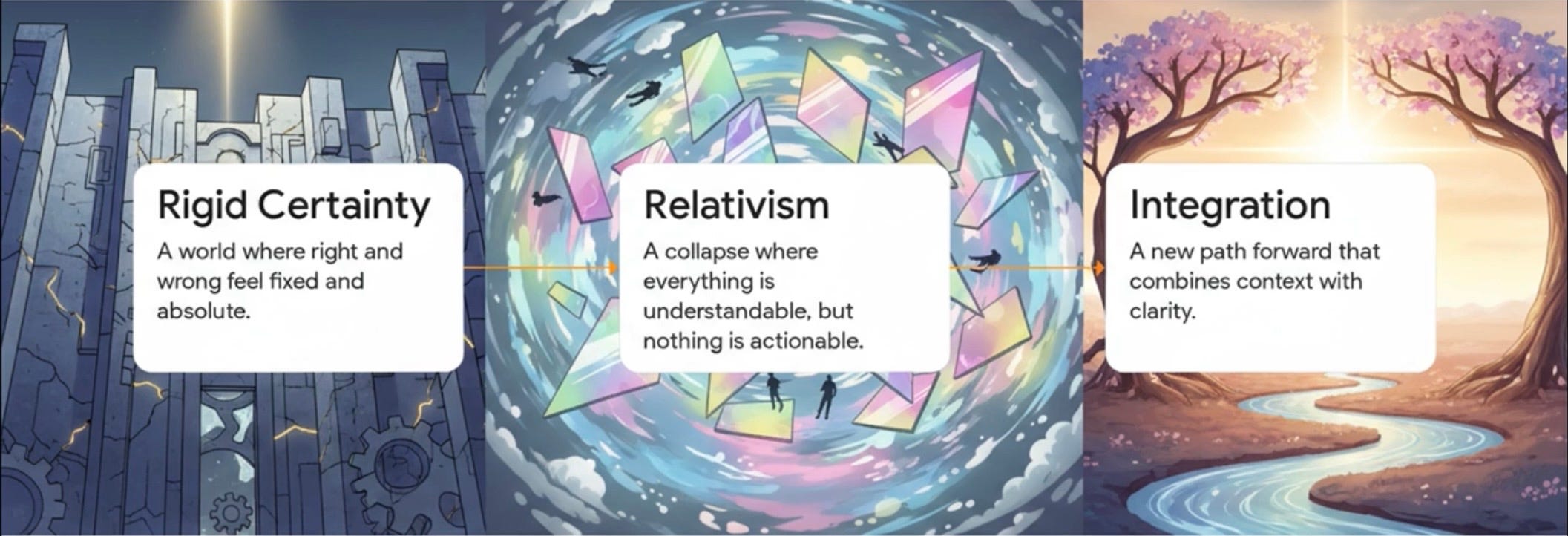
I didn’t want to go backward. I also didn’t want to stay there.
I wanted to understand someone without needing understanding to become approval. I wanted to be able to say that something was harmful without turning the person who did it into a bad human being.
I’m still learning that distinction.
It has changed the way I hear “judge not.”
I don’t know how to live without making judgments in the ordinary sense. I have to decide whether something is safe, whether I trust someone, whether my own behavior is honest, whether to stay or leave.
Maybe discernment isn’t the problem. The problem may be what I sometimes do next: move from evaluating an action to evaluating the worth of the person who took it.
Those aren’t the same thing.
I can believe something you did was harmful without believing you are fundamentally bad. I can love you and not trust you. I can recognize your humanity without giving you access to my life.
If I really believe human worth isn’t something we earn through good behavior, that belief has to survive contact with people whose behavior I don’t like.
That is where this gets uncomfortable.
It’s easy for me to talk about universal love when I’m thinking about people I already know how to love. It gets harder around people whose lives or choices challenge my own moral categories—someone doing sex work, someone exploring Tantra or another spiritual practice I was taught to fear, someone whose religion or politics I strongly oppose.
Understanding someone doesn’t require agreeing with them. But once I turn a person into a category, I don’t have to be curious anymore. I already know what they are.
Then Jesus makes the whole thing even less convenient:
I don’t read that as “trust your enemies,” surrender a boundary, or pretend harm didn’t happen.
But I have a hard time reading “love your enemies” as “love everyone except the people who fail your moral test.”
So I’ve been trying a different question:
What does love require here?
I like the question because it doesn’t tell me the answer.
Sometimes love may move me closer. Sometimes it may require distance. It might mean listening, telling the truth, setting a boundary, changing my own behavior, or admitting that I don’t understand enough yet.
Love doesn’t remove the need to choose. It changes where I begin.
The Relationship Inside the Sentence
Which brings me back to those two words.
As yourself.
Jesus gives two great commandments: love God and love your neighbor as yourself. I’m not proposing a third. I’m interested in what happens when I make explicit the relationship already inside the second.
For years, I put most of my attention on God and neighbor. But if the instruction is to love my neighbor as myself, then my relationship with myself is already in there.
That became more interesting when I started questioning another assumption: that love itself had to be earned.
One of the spiritual ideas that has become important to me is the possibility that belonging comes before performance. I use Source as an inclusive word for the deepest origin of that belonging. In a Christian context I might say God or Father. Gnostic traditions use different language. A Course in Miracles has its own theology.
I don’t think these are secretly interchangeable. They have simply opened related questions for me.
What if I don’t have to make myself worthy enough to be loved by Source? What if love is already there, and some of the work is learning not to exclude myself from it?
That is where I arrived at a line that isn’t in Jesus’s commandments but helps me hear them differently:
Love yourself as you are already loved.
At first, I placed it between the two commandments almost literally:
Love Source. Love yourself as you are already loved. Love your neighbor as yourself.
Source. Self. Other.
I like the simplicity of that. I also don’t want to make it neater than it is.
Enough Ground to Stand On
Almost any beautiful idea can get strange when I use it to escape reality. Self-love can become self-indulgence. Love for another person can become self-abandonment. Devotion to God can become a way of avoiding responsibility here.
So “love yourself as you are already loved” can’t mean everything I do is good because I am good.
For me, it means my worth doesn’t have to be the thing I put on trial every time I discover that I was wrong.
Strangely, that has made accountability easier.
If admitting I hurt someone means admitting I am fundamentally bad, I have a pretty strong incentive to defend myself. If my worth isn’t what’s being decided, I have more room to look at what happened and ask what I owe now.
Maybe I was wrong. Maybe I need to apologize or repair something. Maybe I need to stop. Maybe the consequence is mine to carry.
Love doesn’t make those questions disappear. It gives me enough ground to stand on while I answer them.
That is what Integration is beginning to mean to me. Not a more sophisticated certainty. More like learning to keep things connected without pretending they are identical.
Context matters. So does consequence. And love needs discernment if it is going to survive outside of an idea.
I still don’t know how to resolve every moral question this way. I don’t think I ever will. Sometimes responsibilities conflict. Sometimes every available choice costs something.
But I have a question I trust more than some of the answers I used to carry:
Which available action honors the connection?
Connection to myself. To the other person. To the responsibilities I have accepted. To the world my choice enters. And, in the spiritual picture that makes sense to me, to Source.
I started this inquiry thinking about three directions of love: Source, Self, Other.
I’m not as sure anymore that they behave like arrows.
Maybe that’s the part I’m still working out.
What I do know is that I spent a long time hearing “love your neighbor” as an instruction about how to treat everyone else.
Now I can’t hear it without those last two words.
As yourself.